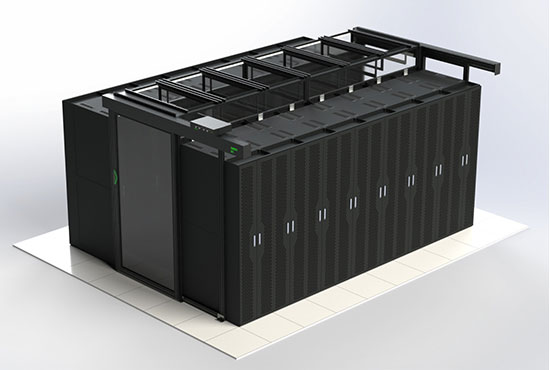
In a data center, Containment is a specific cooling strategy designed to enhance the efficiency of cooling systems by managing airflow within the facility. Here's how it works:
In data centers, servers are typically arranged in rows, with cold air directed to the front of the racks (where the intake fans are) and hot air exiting from the rear. The cold aisle is created by aligning the front of the server racks in rows facing each other, with the space between them designated as the cold aisle.
The cold aisle is enclosed with doors or panels at the ends and often covered with a ceiling or ductwork. This containment prevents the cold air from mixing with the hot air expelled by the servers, maintaining a controlled environment where cool air is concentrated in the cold aisle for maximum efficiency.
By isolating the cold air, the air conditioning units can operate more efficiently, as they don’t need to cool the entire room. This reduces the overall power usage effectiveness (PUE), saving energy and costs.
In a data center, the back of server racks (where the hot air is exhausted) face each other, forming a "hot aisle." The front of the racks, where the cool air is drawn in, faces outward, forming the "cold aisle."
The hot aisle is enclosed using doors, panels, or a ceiling above the aisle. This containment traps the hot air in a confined space, preventing it from spilling into the rest of the data center. The hot air is then directed to the cooling units (CRACs or CRAHs) to be processed and recycled as cool air.
By containing and isolating the hot air, HAC allows for more targeted cooling. The cold air is concentrated in the areas where it’s needed (the cold aisle), while the hot air is channeled directly to the cooling system without mixing with the rest of the data center’s environment.
By preventing hot air from mixing with cold air, the cooling system operates more efficiently, reducing energy consumption.
Since cooling systems don't need to work as hard to manage the entire room's temperature, the overall power usage decreases.
More precise cooling helps avoid overheating in server racks and potential equipment failures.
The cold aisle is fully enclosed and isolated from the surrounding space, with doors or partitions at both ends and sometimes a roof or top panels. This containment ensures that cool air is only concentrated in the cold aisle.
Stand-alone CAC systems often come with their own cooling units or can be linked to dedicated in-row cooling units. These units provide cool air directly to the cold aisle, making it independent of the broader data center's air conditioning system.
The stand-alone system prevents cool air from escaping and hot air from entering, ensuring the server racks receive a stable supply of cool air. The hot air expelled from the racks is managed separately, often exhausted into the data center's broader space or collected for processing.
This type of containment can be added to specific rows of racks, making it ideal for smaller data centers or when specific high-density areas need enhanced cooling without revamping the entire cooling infrastructure.
By containing the cold air where it’s needed most, less cooling power is wasted, which can lead to reduced energy consumption.
Stand-alone CAC systems can be added incrementally, allowing for phased upgrades as the data center grows or when certain areas require enhanced cooling.
These systems can be a cost-effective way to improve cooling performance without needing to redesign the entire data center's cooling system.
It allows specific rows or sections to be cooled more effectively, which is beneficial for high-density or mission-critical equipment.
HAC isolates the hot air, while CAC isolates the cold air.
HAC tends to be more energy-efficient in certain setups, particularly when there are higher density racks or more heat generated per rack.
CAC is often preferred in retrofitting existing data centers, while HAC is sometimes favored in new data center builds for optimal efficiency.
When an existing data center needs improved cooling in specific areas but cannot undergo a full redesign.
For data centers that have certain areas with higher-density servers that need more focused cooling.
Smaller data centers or edge facilities that require efficient cooling solutions on a smaller scale.
Flexibility, modularity, functionality and design are key criteria when selecting a suitable enclosure.
Our pledge to service, which provides us with a cutting edge to guarantee customer satisfaction.